Kamala — The Lotus Goddess
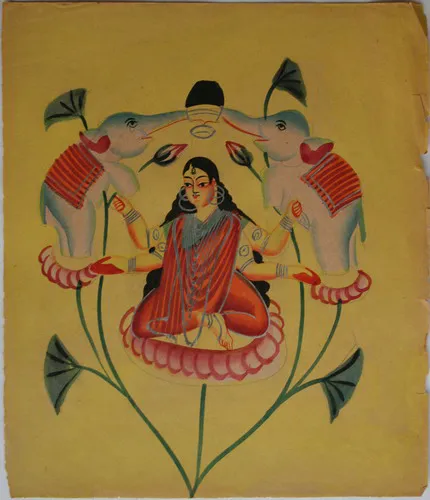
The tenth Mahavidya — Lakshmi as the fullness of grace, beauty and prosperity, bathed by elephants.
- Sanskrit
- कमला (Kamalā)
- Also known as
- Kamalatmika, Gaja Lakshmi
- Nature
- Gentle (Saumya)
- Graha (traditional)
- Venus (Shukra)
Iconography
Golden-skinned and seated on a lotus in a lotus pond. Two elephants pour water over her from pitchers. She holds lotuses in two hands, while the others show the gestures of blessing and fearlessness.
Legend
Kamala is Lakshmi as she rose from the churning of the Ocean of Milk, holding a lotus — the moment when beauty and plenty emerged after a long struggle between gods and demons. As a Mahavidya she is seen not only as Vishnu’s consort but as an independent, complete form of the great goddess.
Significance
The series of ten moves from Kali — the dissolution of all — to Kamala, the full flowering of the world. She shows that spiritual life does not reject wellbeing: the lotus grows from mud, yet stays clean, and abundance is honoured as a form of the Devi.
Graha association
Associated with Venus, the planet of beauty, comfort and refinement.
श्रीं
śrīṃ
- How it sounds
- shreem — “shree” with a long ee, ending in a humming “m”
- Meaning
- The Lakshmi-bija. Śrī itself means radiance, auspiciousness and grace; with the bindu it becomes the seed of the goddess of fortune.
ॐ श्रीं ह्रीं श्रीं कमले कमलालये प्रसीद प्रसीद श्रीं ह्रीं श्रीं महालक्ष्म्यै नमः
oṃ śrīṃ hrīṃ śrīṃ kamale kamalālaye prasīda prasīda śrīṃ hrīṃ śrīṃ mahālakṣmyai namaḥ
O Kamala, you who dwell in the lotus — be gracious, be gracious. Salutations to Mahalakshmi. The seeds śrīṃ and hrīṃ open and close the prayer.
Mantras are given as most commonly printed in stotra collections; spellings and forms vary between lineages. Shared for knowledge only — see the caution above.
Mantras by number of syllables
Tantric texts name a goddess’s mantras by how many syllables (akshara) they hold — one, three, five and so on. These are the forms most commonly printed for her.
- One-syllable seed (ekakshari) · 1 syllable
श्रीं
śrīṃ
Shared for knowledge. Longer Mahavidya mantras are traditionally received from a guru with initiation — see the caution at the top of this page.
Verify it yourself
We cross-checked the beej and mantra above against these independent sources. Forms vary between them; where they differed we used the form found in at least two.