Matangi — Goddess of Inner Speech
The green-hued Tantric Saraswati — music, eloquence and the sacredness of what society calls impure.
- Sanskrit
- मातङ्गी (Mātaṅgī)
- Also known as
- Raja Matangi, Uchchhishta Chandalini, Tantric Saraswati
- Nature
- Fierce & gentle
- Graha (traditional)
- Sun (Surya)
Iconography
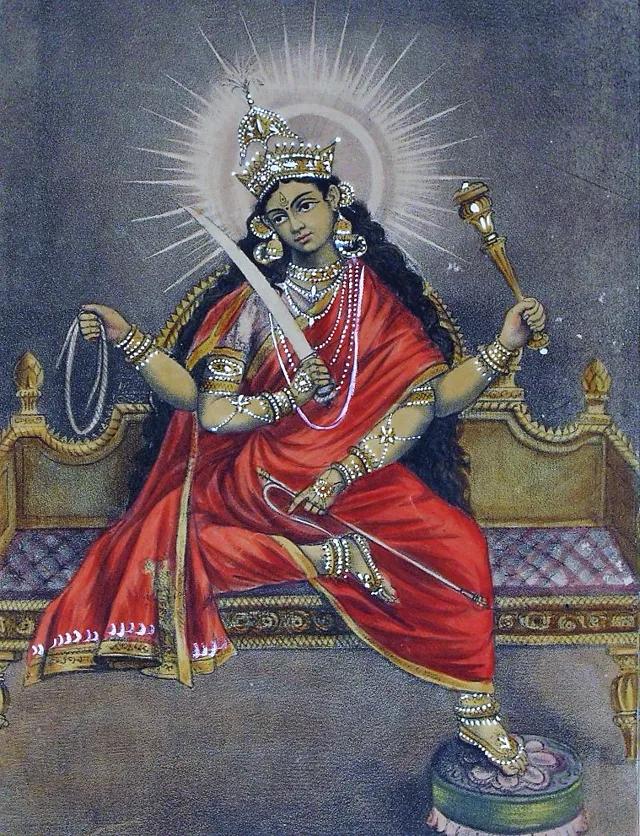
Emerald-green or dark in colour, often holding a veena and accompanied by a parrot. Some forms carry a noose, goad, sword and shield. She is offered leftover food (uchchhishta) — something normally considered polluting.
Legend
Shiva and Parvati once visited Vishnu and Lakshmi and were served a feast. Bits of food fell to the ground, and from those leftovers rose a dark maiden who asked to eat what remained. Shiva granted that offerings of leftovers made to her would be fruitful — and she became Uchchhishta Matangi. In another account Parvati takes the form of a Chandala huntress to test Shiva’s love.
Significance
Matangi breaks the line between “pure” and “impure”, teaching that the divine is present even in what is rejected. She rules speech before it is spoken — thought, music and inspiration — and is honoured by artists, musicians and scholars.
Graha association
In the most common correspondence list she is paired with the Sun; a few lineages instead link her with Mercury.
ऐं
aiṃ
- How it sounds
- aim — rhymes with “time”, closed by a soft humming “m”
- Meaning
- The vagbija, seed of speech and learning — the same seed as Saraswati, which fits Matangi’s role as the “Tantric Saraswati”. Her printed mantra below uses the seeds hrīṃ, klīṃ and hūṃ instead.
ॐ ह्रीं क्लीं हूं मातङ्ग्यै फट् स्वाहा
oṃ hrīṃ klīṃ hūṃ mātaṅgyai phaṭ svāhā
Om — three seeds — to Matangi; phaṭ (removing obstacles) and svāhā (offering).
Mantras are given as most commonly printed in stotra collections; spellings and forms vary between lineages. Shared for knowledge only — see the caution above.
Mantras by number of syllables
Tantric texts name a goddess’s mantras by how many syllables (akshara) they hold — one, three, five and so on. These are the forms most commonly printed for her.
- One-syllable seed (ekakshari) · 1 syllable
ऐं
aiṃ
- Ten-syllable mantra (dashakshari) · 10 syllables
ॐ ह्रीं क्लीं हूं मातङ्ग्यै फट् स्वाहा
oṃ hrīṃ klīṃ hūṃ mātaṅgyai phaṭ svāhā
Shared for knowledge. Longer Mahavidya mantras are traditionally received from a guru with initiation — see the caution at the top of this page.
Verify it yourself
We cross-checked the beej and mantra above against these independent sources. Forms vary between them; where they differed we used the form found in at least two.