Tara — The One Who Carries Across
The saviour goddess who ferries beings across the ocean of suffering; blue-skinned, fierce, and deeply maternal.
- Sanskrit
- तारा (Tārā)
- Also known as
- Ugra Tara, Nila Saraswati, Ekajata
- Nature
- Fierce (Ugra)
- Graha (traditional)
- Jupiter (Guru)
Iconography
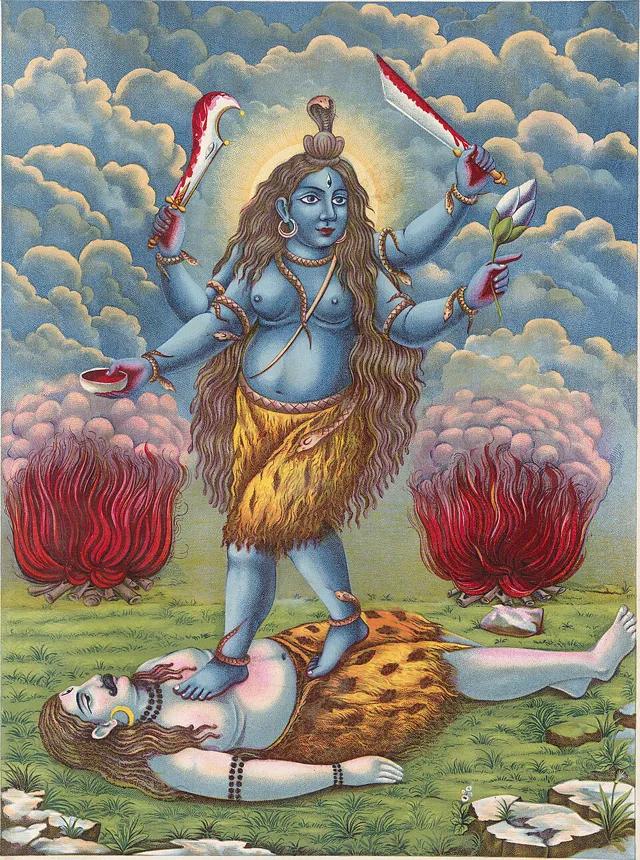
Blue in colour, short and pot-bellied, standing on a corpse or on Shiva on a cremation ground. She wears a tiger skin and a garland of heads, with a single matted lock of hair. Her four hands carry a sword, a pair of shears, a blue lotus and a skull-cup.
Legend
A well-loved Bengali story tells that when Shiva drank the poison churned from the cosmic ocean, it burned in his throat until he fell unconscious. Tara took him on her lap and nursed him like an infant, and the milk drew out the poison’s fire. Her best-known shrine is Tarapith in Bengal, closely linked with the 19th-century saint Bamakhepa.
Significance
Her name comes from the root “tṛ”, to cross. Where Kali is time, Tara is the word and guiding light that gets one safely through it — she is associated with speech, sudden insight and protection in danger. She is also revered in Buddhism, in a related but distinct form.
Graha association
Associated with Jupiter, the planet of guidance and knowledge, in the traditional Mahavidya–graha list.
स्त्रीं
strīṃ
- How it sounds
- streem — “s-tree” said as one beat, ending in a humming “m”
- Meaning
- Tara’s seed syllable (vadhu-bija). Commentators read s as deliverance, t as crossing over, r as purifying fire and ī with the bindu as the goddess who completes the passage.
ॐ ह्रीं स्त्रीं हूं फट्
oṃ hrīṃ strīṃ hūṃ phaṭ
Tara’s widely printed five-syllable mantra: seeds of the Devi (hrīṃ), of Tara (strīṃ) and of protective power (hūṃ), ending with phaṭ, a sound that cuts through obstacles.
Mantras are given as most commonly printed in stotra collections; spellings and forms vary between lineages. Shared for knowledge only — see the caution above.
Mantras by number of syllables
Tantric texts name a goddess’s mantras by how many syllables (akshara) they hold — one, three, five and so on. These are the forms most commonly printed for her.
- One-syllable seed (ekakshari) · 1 syllable
स्त्रीं
strīṃ
- Five-syllable mantra (panchakshari) · 5 syllables
ॐ ह्रीं स्त्रीं हूं फट्
oṃ hrīṃ strīṃ hūṃ phaṭ
Also known as the Ugra Tara or Ekajata mantra.
Shared for knowledge. Longer Mahavidya mantras are traditionally received from a guru with initiation — see the caution at the top of this page.
Verify it yourself
We cross-checked the beej and mantra above against these independent sources. Forms vary between them; where they differed we used the form found in at least two.