Tripura Sundari — Beauty of the Three Worlds
Shodashi, the sixteen-year-old queen of the universe — beauty, bliss and the Sri Chakra.
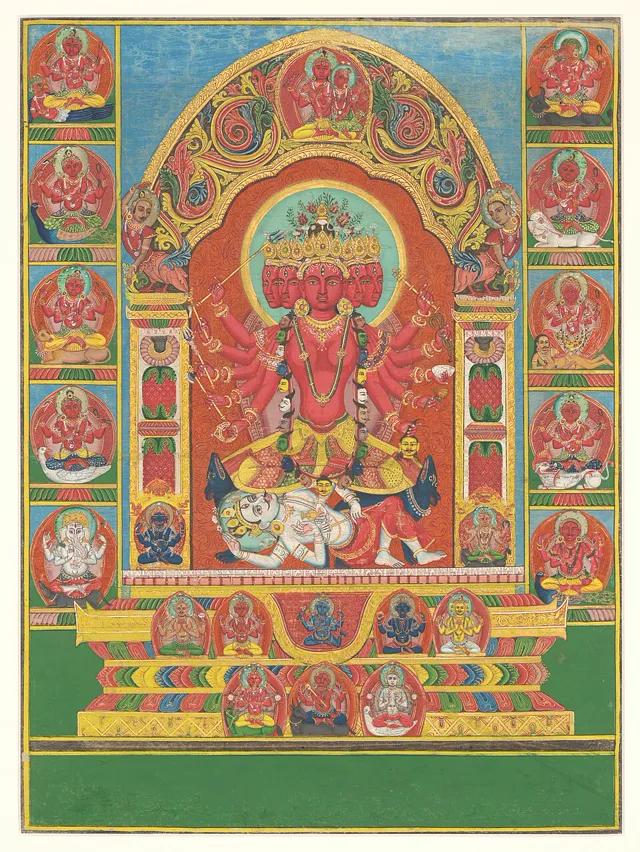
- Sanskrit
- त्रिपुरसुन्दरी (Tripurasundarī)
- Also known as
- Shodashi, Lalita, Rajarajeshvari, Kameshvari
- Nature
- Gentle (Saumya)
- Graha (traditional)
- Mercury (Budh)
Iconography
Radiant like the rising sun, seated on a throne whose legs are the gods Brahma, Vishnu, Rudra and Ishvara, with Sadashiva as its seat. Her four hands hold a noose, an elephant goad, a sugarcane bow and five flower arrows — the tools with which she draws the mind in and then steers it.
Legend
In the Lalitopakhyana of the Brahmanda Purana she rises from a sacrificial fire to defeat Bhandasura, a demon born from the ashes of Kama, the god of desire whom Shiva had burned. After the victory she restores Kama to life — showing that desire, rightly placed, is not destroyed but transformed. The thousand names of the Lalita Sahasranama are sung to her.
Significance
She is the centre of the Shri Vidya tradition and is worshipped through the Sri Yantra. Where Kali dissolves the world, Tripura Sundari shows the same reality as beauty and delight; the “three cities” of her name are read as waking, dreaming and deep sleep, or as body, mind and causal self.
Graha association
Traditionally associated with Mercury, the planet of intellect and discernment.
ह्रीं
hrīṃ
- How it sounds
- hreem — a breathy “h” flowing straight into “ree”, ending in “m”
- Meaning
- Popular lists give her the same seed as Bhuvaneshvari — hrīṃ, the power of the Devi. Her commonly printed mantra adds aiṃ (knowledge, Saraswati) and śrīṃ (grace, Lakshmi). Her full fifteen-syllable Panchadashi mantra is traditionally received only from a guru.
ॐ ऐं ह्रीं श्रीं त्रिपुरसुन्दर्यै नमः
oṃ aiṃ hrīṃ śrīṃ tripurasundaryai namaḥ
Om — seeds of wisdom, power and grace — salutations to Tripura Sundari.
Mantras are given as most commonly printed in stotra collections; spellings and forms vary between lineages. Shared for knowledge only — see the caution above.
Mantras by number of syllables
Tantric texts name a goddess’s mantras by how many syllables (akshara) they hold — one, three, five and so on. These are the forms most commonly printed for her.
- One-syllable seed (ekakshari) · 1 syllable
ह्रीं
hrīṃ
- Fifteen-syllable Panchadashi (Shri Vidya, kadi form) · 15 syllables
क ए ई ल ह्रीं ह स क ह ल ह्रीं स क ल ह्रीं
ka e ī la hrīṃ ha sa ka ha la hrīṃ sa ka la hrīṃ
Three groups (kutas) of five, six and four syllables, each closing with ह्रीं. In the Shri Vidya tradition it is received only through initiation; adding a sixteenth seed makes the Shodashi.
Shared for knowledge. Longer Mahavidya mantras are traditionally received from a guru with initiation — see the caution at the top of this page.
Verify it yourself
We cross-checked the beej and mantra above against these independent sources. Forms vary between them; where they differed we used the form found in at least two.