Bagalamukhi — The One Who Paralyses
The yellow-clad goddess who stops the enemy’s tongue — the power of stillness and silencing falsehood.
- Sanskrit
- बगलामुखी (Bagalāmukhī)
- Also known as
- Pitambara, Brahmastra Vidya
- Nature
- Fierce (Ugra)
- Graha (traditional)
- Mars (Mangal)
Iconography
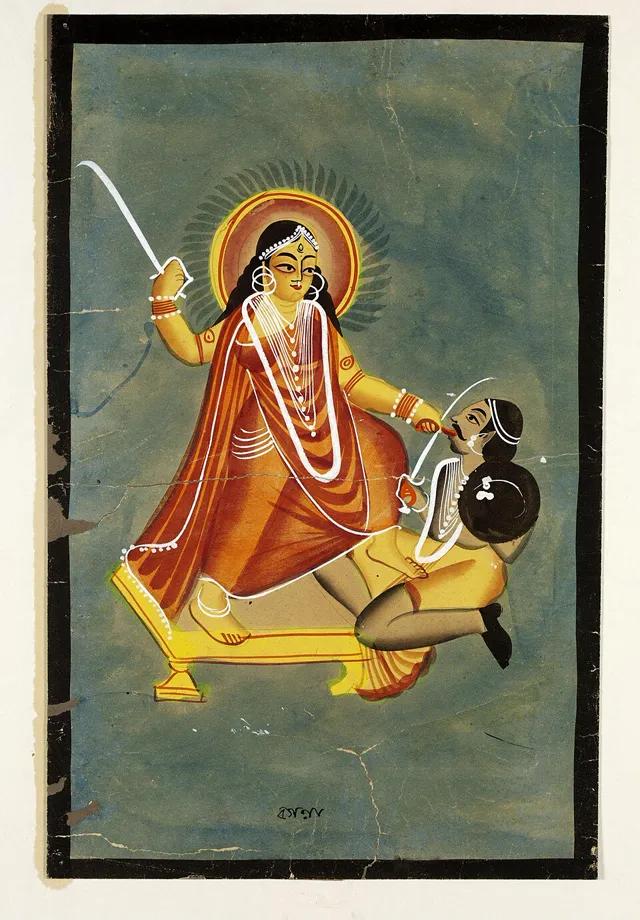
Golden-skinned and dressed in yellow, seated on a throne amid an ocean of nectar. With one hand she pulls the tongue of a demon; with the other she raises a club to strike him. Yellow — the colour of turmeric and of the earth element — dominates her worship.
Legend
A cosmic storm once threatened to destroy creation. Vishnu performed austerities on the shore of Haridra Sarovar, the “turmeric lake” in Saurashtra, and Bagalamukhi rose from its yellow waters to still the storm. Another story tells of the demon Madan, whose spoken words came true; she seized his tongue so that his speech could do no more harm.
Significance
Bagalamukhi embodies stambhana — bringing motion to a halt. Inwardly this is read as stilling the restless mind and the reckless tongue; outwardly as the triumph of truth over slander and deceit. Datia in Madhya Pradesh and Nalkheda are among her well-known shrines.
Graha association
Traditionally associated with Mars, the planet of conflict, courage and contests.
ह्लीं
hlīṃ
- How it sounds
- hleem — breathy “h” sliding into “lee”, ending in “m”
- Meaning
- Her seed adds l — the syllable of the earth element, stability and firmness — to the h and ī of Devi’s power: the energy that makes things stand still.
ॐ ह्लीं बगलामुखी देव्यै ह्लीं ॐ नमः
oṃ hlīṃ bagalāmukhī devyai hlīṃ oṃ namaḥ
Om — (seed) hlīṃ — to the goddess Bagalamukhi — hlīṃ, Om, salutations. The seed and Om frame the name on both sides.
Mantras are given as most commonly printed in stotra collections; spellings and forms vary between lineages. Shared for knowledge only — see the caution above.
Mantras by number of syllables
Tantric texts name a goddess’s mantras by how many syllables (akshara) they hold — one, three, five and so on. These are the forms most commonly printed for her.
- One-syllable seed (ekakshari) · 1 syllable
ह्लीं
hlīṃ
- Thirty-six-syllable mantra (shattrimshakshari) · 36 syllables
ॐ ह्लीं बगलामुखि सर्वदुष्टानां वाचं मुखं पदं स्तम्भय जिह्वां कीलय बुद्धिं विनाशय ह्लीं ॐ स्वाहा
oṃ hlīṃ bagalāmukhi sarvaduṣṭānāṃ vācaṃ mukhaṃ padaṃ stambhaya jihvāṃ kīlaya buddhiṃ vināśaya hlīṃ oṃ svāhā
The words ask her to still the speech, face and steps of all who would do harm, to bind their tongue and undo their schemes — her power of stambhana (paralysis).
Shared for knowledge. Longer Mahavidya mantras are traditionally received from a guru with initiation — see the caution at the top of this page.
Verify it yourself
We cross-checked the beej and mantra above against these independent sources. Forms vary between them; where they differed we used the form found in at least two.