Dhumavati — The Smoky Widow
The old widow goddess of smoke and emptiness — wisdom found in loss, disappointment and letting go.
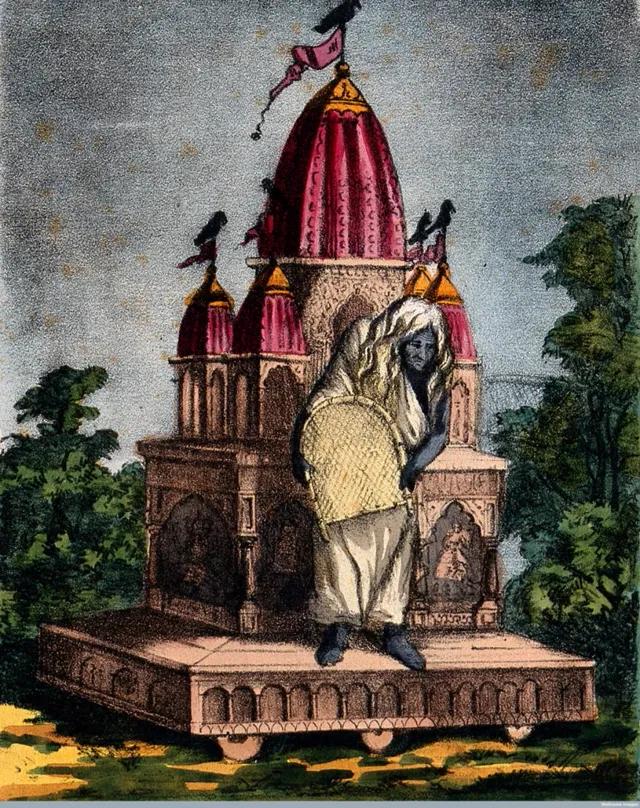
- Sanskrit
- धूमावती (Dhūmāvatī)
- Also known as
- Alakshmi (in some texts), Jyeshtha
- Nature
- Fierce (Ugra)
- Graha (traditional)
- Ketu
Iconography
An old, pale, lean woman in dirty white clothes, with dishevelled grey hair and missing teeth. She rides a chariot without horses, its banner bearing a crow, and carries a winnowing basket. She is the only Mahavidya shown without a consort.
Legend
One telling says that Parvati, overcome by hunger, asked Shiva for food; when he delayed, she swallowed Shiva himself. Smoke poured from her body, and Shiva, emerging, declared that she would now be worshipped as a widow — Dhumavati. Another account says she arose from the smoke of Sati’s self-immolation at Daksha’s sacrifice.
Significance
Dhumavati is what remains when everything pleasant has been taken away. She teaches that disappointment and old age, faced honestly, strip away illusions and leave clear understanding. Smoke hides fire — and she is the hidden spark inside dark times.
Graha association
Associated with Ketu, the “tail” node traditionally linked with detachment and renunciation.
धूं
dhūṃ
- How it sounds
- dhoom — a breathy “dh” (as in “adhere”, said softly) and long oo, ending in “m”
- Meaning
- Her seed is the first syllable of dhūma, “smoke” — the veil that both conceals and reveals the fire beneath.
ॐ धूं धूं धूमावती देव्यै स्वाहा
oṃ dhūṃ dhūṃ dhūmāvatī devyai svāhā
Om — the smoke-seed twice — an offering (svāhā) to the goddess Dhumavati.
Mantras are given as most commonly printed in stotra collections; spellings and forms vary between lineages. Shared for knowledge only — see the caution above.
Mantras by number of syllables
Tantric texts name a goddess’s mantras by how many syllables (akshara) they hold — one, three, five and so on. These are the forms most commonly printed for her.
- One-syllable seed (ekakshari) · 1 syllable
धूं
dhūṃ
- Eight-syllable mantra (ashtakshari) · 8 syllables
धूं धूं धूमावती ठः ठः
dhūṃ dhūṃ dhūmāvatī ṭhaḥ ṭhaḥ
Some lineages end it with स्वाहा instead.
Shared for knowledge. Longer Mahavidya mantras are traditionally received from a guru with initiation — see the caution at the top of this page.
Verify it yourself
We cross-checked the beej and mantra above against these independent sources. Forms vary between them; where they differed we used the form found in at least two.