Bhairavi — The Formidable One
The fiery consort of Bhairava — the heat of discipline (tapas) that burns away what blocks the seeker.
- Sanskrit
- भैरवी (Bhairavī)
- Also known as
- Tripura Bhairavi
- Nature
- Fierce & gentle
- Graha (traditional)
- Ascendant (Lagna)
Iconography
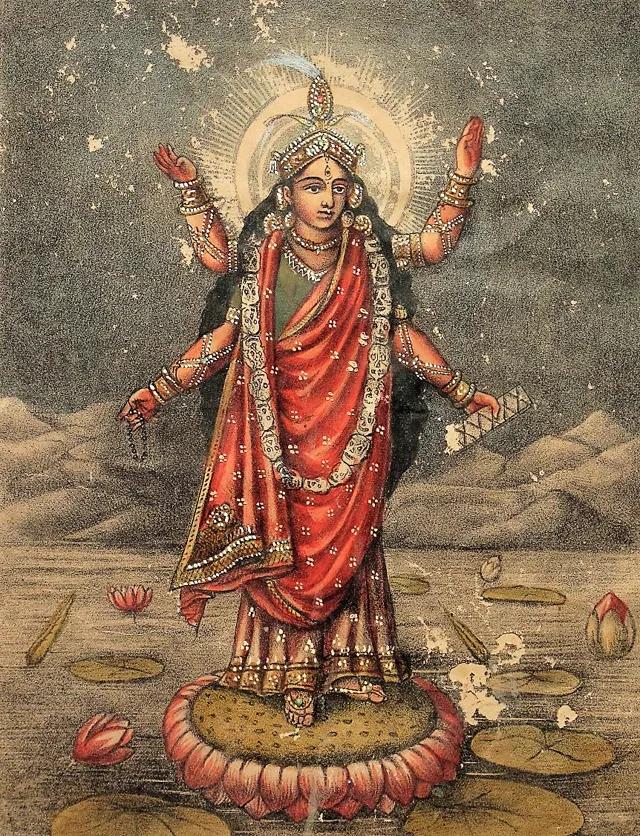
Glowing red like a thousand rising suns, dressed in red with a garland of heads and a crescent moon. Her hands hold a rosary and a book, while the other two show fearlessness and blessing; some forms instead carry a sword and a skull-cup. She is sometimes seated on a corpse or a lotus.
Legend
In the Devi Mahatmya cycle the fierce goddess who slays Chanda, Munda and other demons is sometimes identified with Bhairavi, and she is honoured as the power behind Bhairava, Shiva’s terrifying form. Bengal remembers the 19th-century Bhairavi Brahmani, a woman teacher who guided Sri Ramakrishna through Tantric disciplines — a living reminder that the name also means a female adept.
Significance
Bhairavi is the inner fire that rises when one commits fully — the energy of transformation, purification and steady practice. She is seen as both destroyer of inner obstacles and the warm, awakening heat of devotion.
Graha association
In the common list she is linked not with a planet but with the Lagna, the rising sign that stands for the self.
ह्स्रौं
hsrauṃ
- How it sounds
- h-sraum — a quick “h” and “s” together, then “rau” as in “round”, ending in “m”
- Meaning
- A compound seed of Tripura Bhairavi: h (Shiva), s (Shakti), r (fire) and au with the bindu — consciousness and energy joined in fire. It closes her well-known three-part seed mantra shown below.
ॐ ह्स्रैं ह्स्क्ल्रीं ह्स्रौः
oṃ hsraiṃ hsklrīṃ hsrauḥ
Her three compound seeds, one for each of the three “cities” (tripura) — creation, sustenance and dissolution. These clusters are almost unpronounceable from text alone, which is exactly why they are taught orally.
Mantras are given as most commonly printed in stotra collections; spellings and forms vary between lineages. Shared for knowledge only — see the caution above.
Mantras by number of syllables
Tantric texts name a goddess’s mantras by how many syllables (akshara) they hold — one, three, five and so on. These are the forms most commonly printed for her.
- One-syllable seed (ekakshari) · 1 syllable
ह्स्रौं
hsrauṃ
- Three-syllable mantra (tryakshari) · 3 syllables
ह्स्रैं ह्स्क्ल्रीं ह्स्रौः
hsraiṃ hsklrīṃ hsrauḥ
Each “syllable” is a compound seed. Spellings vary a little between printings (some write ह्स्त्रैं … ह्स्त्रौंः), and many prefix ॐ.
Shared for knowledge. Longer Mahavidya mantras are traditionally received from a guru with initiation — see the caution at the top of this page.
Verify it yourself
We cross-checked the beej and mantra above against these independent sources. Forms vary between them; where they differed we used the form found in at least two.