Chhinnamasta — The Self-Decapitated Goddess
The goddess who cuts off her own head to feed others — self-sacrifice and the life-force flowing in a circle.
- Sanskrit
- छिन्नमस्ता (Chinnamastā)
- Also known as
- Prachanda Chandika, Vajra Vairochani
- Nature
- Fierce (Ugra)
- Graha (traditional)
- Rahu
Iconography
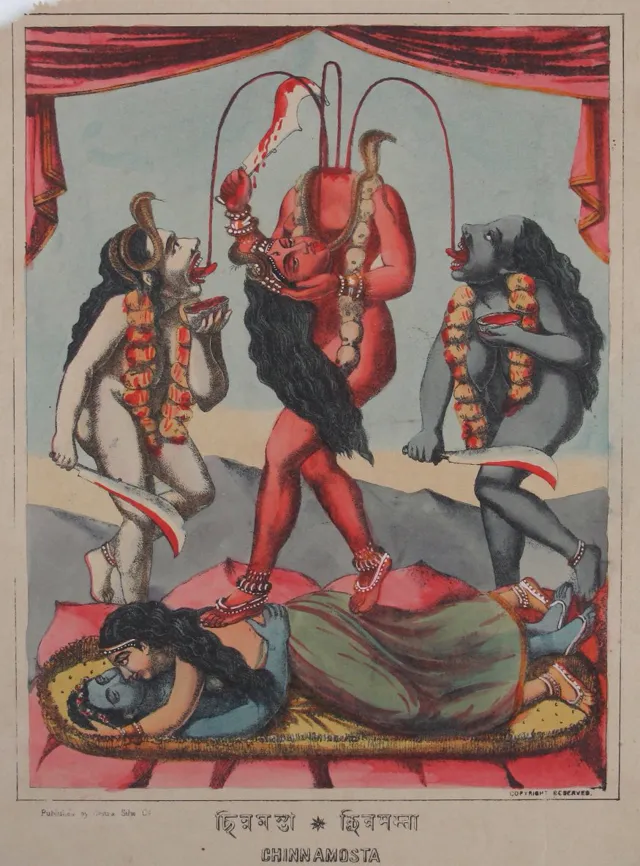
She holds her own severed head in one hand and a blade in the other. Three streams of blood spring from her neck: one into her own mouth and one each into the mouths of her two attendants, Dakini and Varnini. She stands on a copulating couple — usually Kama and Rati — resting on a lotus.
Legend
One account tells that after bathing in the Mandakini river with her companions Jaya and Vijaya, the goddess was asked for food by her hungry attendants. With nothing at hand, she cut off her own head, and the three streams of blood fed all three of them. Her best-known temple is at Rajrappa in Jharkhand.
Significance
A startling image of giving that loses nothing: the goddess is both the one who offers and the one who is nourished. Standing over Kama and Rati, she shows desire’s energy being mastered and turned upward rather than denied. Many read her as a symbol of the awakened life-force rising through the body.
Graha association
Linked with Rahu — the “head without a body” of the eclipse myth, echoing her own severed head.
हूं
hūṃ
- How it sounds
- hoom — like “who” with a long oo, closed by a humming “m”
- Meaning
- The kurcha-bija, a seed of fierce, protective power that “cuts away”. It appears in her widely printed mantra ending in hūṃ hūṃ phaṭ svāhā.
श्रीं ह्रीं क्लीं ऐं वज्रवैरोचनीये हूं हूं फट् स्वाहा
śrīṃ hrīṃ klīṃ aiṃ vajravairocanīye hūṃ hūṃ phaṭ svāhā
Her well-known mantra: four seeds (grace, power, attraction, wisdom), then an address to Vajra Vairochani — “the radiant one of the thunderbolt” — and closing syllables of protection and offering.
Mantras are given as most commonly printed in stotra collections; spellings and forms vary between lineages. Shared for knowledge only — see the caution above.
Mantras by number of syllables
Tantric texts name a goddess’s mantras by how many syllables (akshara) they hold — one, three, five and so on. These are the forms most commonly printed for her.
- One-syllable seed (ekakshari) · 1 syllable
हूं
hūṃ
Shared for knowledge. Longer Mahavidya mantras are traditionally received from a guru with initiation — see the caution at the top of this page.
Verify it yourself
We cross-checked the beej and mantra above against these independent sources. Forms vary between them; where they differed we used the form found in at least two.