Bhuvaneshvari — Queen of the Worlds
The goddess as space itself — the vast field in which all worlds appear and are held.
- Sanskrit
- भुवनेश्वरी (Bhuvaneśvarī)
- Also known as
- Mayabija Devi, Jagaddhatri (in some traditions)
- Nature
- Gentle (Saumya)
- Graha (traditional)
- Moon (Chandra)
Iconography
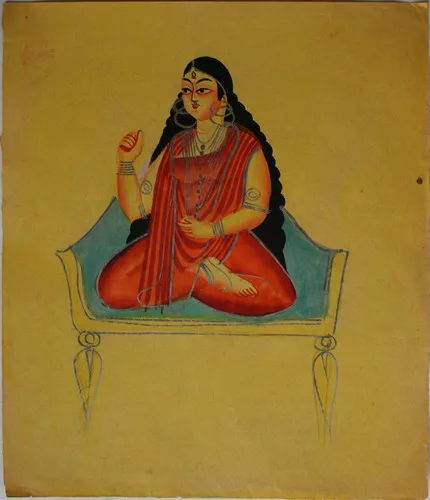
Fair and gentle, with a crescent moon in her crown and three eyes. Two hands hold a noose and a goad; the other two make the gestures of granting boons and of reassurance. She is often shown seated calmly on a lotus or throne, smiling.
Legend
In the Devi Bhagavata Purana, when Brahma, Vishnu and Shiva are carried to her island of gems, they see her as the mother of the cosmos and each of them, briefly, as a woman in her service — a picture of how even the great gods arise within her. Space is her body: before anything can exist, there must be room for it, and that room is Bhuvaneshvari.
Significance
Her seed hrīṃ is called the Mayabija and appears in countless Devi mantras. She represents openness and the power that makes manifestation possible; contemplating her is a way of seeing the world as held inside a single, loving awareness.
Graha association
Paired with the Moon in the traditional list — both are linked with nurture and the receptive mind.
ह्रीं
hrīṃ
- How it sounds
- hreem — a breathy “h” flowing straight into “ree”, ending in “m”
- Meaning
- The Mayabija. Traditionally read as h (space / Shiva), r (fire / energy), ī (the goddess’s power of manifestation) and the bindu (the point beyond form).
ॐ ह्रीं श्रीं क्लीं ऐं सौः भुवनेश्वर्यै नमः
oṃ hrīṃ śrīṃ klīṃ aiṃ sauḥ bhuvaneśvaryai namaḥ
Om — seeds of power (hrīṃ), grace (śrīṃ), attraction (klīṃ), knowledge (aiṃ) and the life-force (sauḥ) — salutations to Bhuvaneshvari, ruler of the worlds. Many lineages use the single seed hrīṃ on its own.
Mantras are given as most commonly printed in stotra collections; spellings and forms vary between lineages. Shared for knowledge only — see the caution above.
Mantras by number of syllables
Tantric texts name a goddess’s mantras by how many syllables (akshara) they hold — one, three, five and so on. These are the forms most commonly printed for her.
- One-syllable seed (ekakshari) · 1 syllable
ह्रीं
hrīṃ
Shared for knowledge. Longer Mahavidya mantras are traditionally received from a guru with initiation — see the caution at the top of this page.
Verify it yourself
We cross-checked the beej and mantra above against these independent sources. Forms vary between them; where they differed we used the form found in at least two.